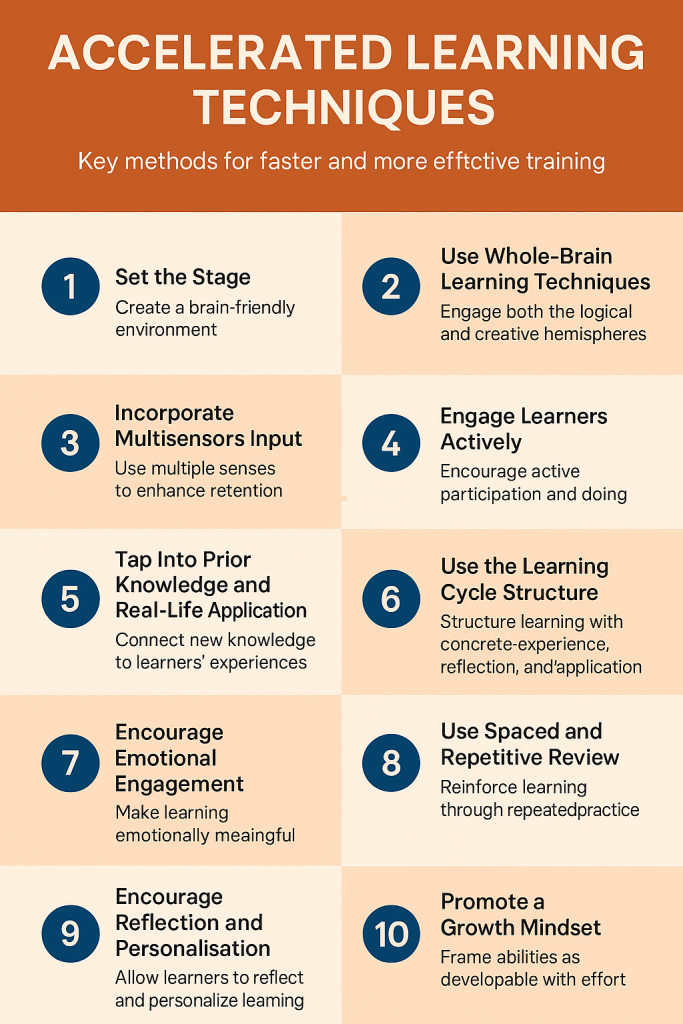
Accelerated learning (AL) is a learner-centred, brain-friendly approach that increases the speed, retention, and enjoyment of learning. It draws on the latest research in neuroscience, psychology, and adult education to help trainers design sessions that are highly engaging and effective. This guide outlines key accelerated learning techniques and how trainers can apply them directly in their training delivery.
1. Set the Stage: Create a Brain-Friendly Environment
A positive, supportive learning environment is fundamental. The brain is more receptive to learning when learners feel relaxed, emotionally safe, and physically comfortable (Jensen, 2008).
How to Apply:
Arrange the room to encourage movement and interaction (e.g. circles or pods instead of rows).
Use colours, plants, music, and natural lighting to create an inviting space.
Start with an icebreaker or energiser to build rapport and reduce anxiety.
Tip: Soft background music during arrival or breaks helps induce a relaxed, alert state conducive to learning (Lozanov, 1978).
2. Use Whole-Brain Learning Techniques
Learning is accelerated when both the logical (left brain) and creative (right brain) hemispheres are engaged (Rose, 1997).
How to Apply:
Use mind maps, visual aids, and diagrams for the visual-spatial learner.
Integrate music, stories, and role-play for auditory and kinesthetic engagement.
Offer tasks that involve movement, such as gallery walks or physical simulations.
Tip: Encourage learners to draw or sketch concepts instead of only writing notes.
3. Incorporate Multisensory Input
The more senses involved in the learning process, the greater the retention (Sousa, 2011).
How to Apply:
Include tactile materials like flashcards, props, or manipulatives.
Combine visual slides with spoken explanation and hands-on activity.
Use real objects or demonstrations to bring abstract ideas to life.
Example: When teaching customer service, provide scenarios with props (e.g. phones, complaint forms) and have learners act them out.
4. Engage Learners Actively
Active participation shifts learners from passive receivers to active constructors of knowledge. Adults retain more when they “do” rather than simply listen (Kolb, 1984).
How to Apply:
Use group discussions, case studies, and problem-solving exercises.
Apply the 80/20 rule: learners should be active 80% of the time.
Use peer teaching—have participants explain concepts to each other.
Tip: Incorporate movement every 20 minutes to reset attention and energy levels.
5. Tap Into Prior Knowledge and Real-Life Application
Adults learn best when new knowledge is relevant and connected to what they already know (Knowles, Holton & Swanson, 2015).
How to Apply:
Begin by asking: “What do you already know about this topic?”
Use case studies or simulations from their own work context.
Have learners set personal goals for how they will apply what they learn.
Example: Before introducing a new model, ask participants how they currently solve similar problems.
6. Use the Learning Cycle Structure
David Kolb’s experiential learning model—Concrete Experience, Reflective Observation, Abstract Conceptualization, and Active Experimentation—supports accelerated learning (Kolb, 1984).
How to Apply:
Experience – Use a real-world scenario or simulation.
Reflect – Facilitate discussion or journaling.
Conceptualize – Introduce the theory or model.
Apply – Let learners test it in a case study or project.
Tip: Design every module or activity to move through these four stages.
7. Encourage Emotional Engagement
Learning sticks when it is emotionally meaningful. Emotions help encode memory and sustain attention (Immordino-Yang & Damasio, 2007).
How to Apply:
Use personal stories, challenges, or successes to connect content to values.
Ask reflective questions: “How does this affect your day-to-day work?”
Celebrate progress and build in moments of fun or surprise.
Example: Use storytelling to explain change models—link theory to lived experiences.
8. Use Spaced and Repetitive Review
Spaced repetition is key to long-term retention (Roediger & Butler, 2011).
How to Apply:
Reinforce key points throughout the session with mini-reviews.
Use quizzes, memory games, or group recaps at regular intervals.
Send a follow-up summary or activity post-training to aid recall.
Tip: Use “teach-backs” where learners explain content to others to reinforce memory.
9. Encourage Reflection and Personalisation
Reflection allows learners to consolidate learning and personalise it to their context (Brookfield, 2017).
How to Apply:
End each module with a reflection question or journaling activity.
Ask learners to identify 3 takeaways and 1 action.
Create space for feedback and dialogue on how the learning is landing.
10. Promote a Growth Mindset
Learners perform better when they believe their abilities can grow with effort (Dweck, 2006).
How to Apply:
Frame mistakes as part of the learning journey.
Use affirming language and acknowledge effort, not just outcomes.
Share examples of improvement over time to build confidence.
Example: Say, “You’re improving quickly with practice,” instead of “You’re good at this.”
Conclusion
Accelerated learning is not a rigid method—it’s a flexible, learner-centred approach grounded in how people naturally learn best. As a trainer, integrating these techniques will help you deliver sessions that are not only faster but also deeper and more memorable. When learners are emotionally engaged, physically active, and cognitively stretched in a safe environment, powerful learning can occur.
References (Harvard Style)
Brookfield, S.D., 2017. Becoming a Critically Reflective Teacher. 2nd ed. San Francisco: Jossey-Bass.
Dweck, C.S., 2006. Mindset: The New Psychology of Success. New York: Random House.
Immordino-Yang, M.H. and Damasio, A., 2007. We feel, therefore we learn: The relevance of affective and social neuroscience to education. Mind, Brain, and Education, 1(1), pp.3–10.
Jensen, E., 2008. Brain-Based Learning: The New Paradigm of Teaching. 2nd ed. Thousand Oaks, CA: Corwin Press.
Knowles, M.S., Holton, E.F. and Swanson, R.A., 2015. The Adult Learner: The Definitive Classic in Adult Education and Human Resource Development. 8th ed. New York: Routledge.
Kolb, D.A., 1984. Experiential Learning: Experience as the Source of Learning and Development. Englewood Cliffs, NJ: Prentice Hall.
Lozanov, G., 1978. Suggestology and Outlines of Suggestopedy. New York: Gordon and Breach.
Roediger, H.L. and Butler, A.C., 2011. The critical role of retrieval practice in long-term retention. Trends in Cognitive Sciences, 15(1), pp.20-27.
Rose, C., 1997. Accelerated Learning: How You Learn Faster and Remember More. London: Accelerated Learning Systems Ltd.
Sousa, D.A., 2011. How the Brain Learns. 4th ed. Thousand Oaks, CA: Corwin Press.
Accelerated Learning Techniques: A Practical Guide for Trainers
 By
/ 06/07/2025
By
/ 06/07/2025