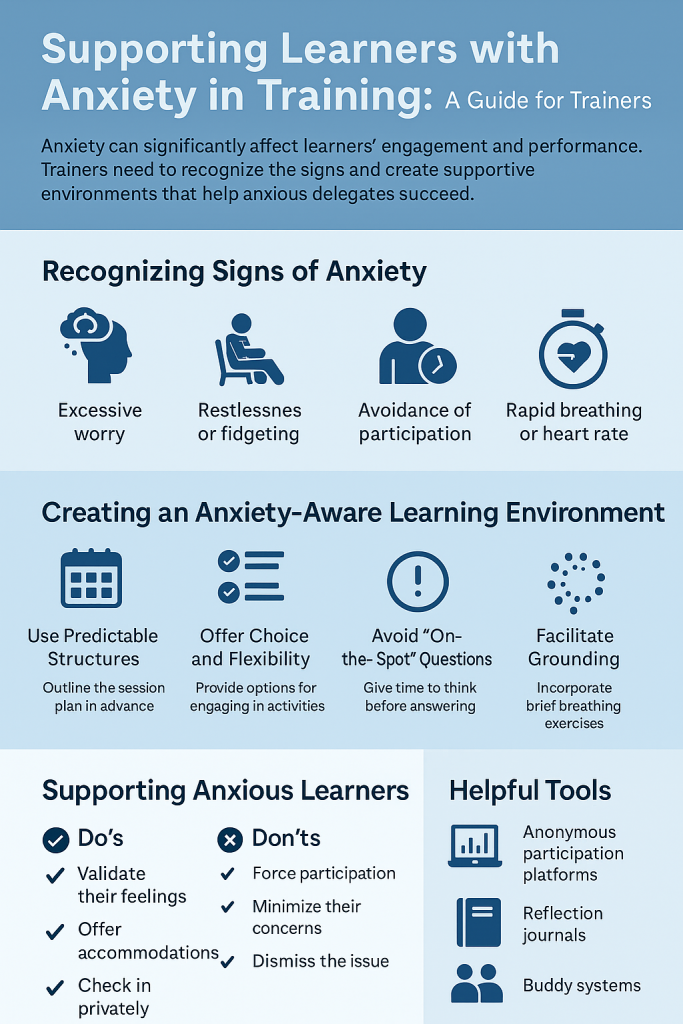
Anxiety is one of the most common mental health conditions and frequently surfaces in learning contexts, especially where performance, group interaction, and unfamiliar environments are involved. As professional trainers, it is essential to understand how anxiety affects learner engagement, communication, and retention — and to proactively design training that supports delegates experiencing anxiety. This guide offers practical strategies and evidence-based approaches for identifying anxiety symptoms, adapting training delivery, and fostering psychologically safe learning environments.
1. Understanding Anxiety in a Learning Context
Anxiety is a state of excessive worry, fear, or nervousness that can interfere with concentration, memory, and performance. While mild anxiety can be a motivator, persistent or severe anxiety can severely limit a learner’s ability to engage with content, activities, or peers (NHS, 2023).
Common symptoms include:
Rapid heartbeat or shallow breathing
Restlessness or fidgeting
Avoidance of participation
Racing thoughts or mental blanks
Perfectionism or fear of failure (APA, 2021)
2. Recognising Anxiety in Delegates
Trainers are not expected to diagnose anxiety but should be alert to behavioural indicators that may signal a delegate is struggling.
Possible signs include:
Repeatedly checking information or instructions
Avoiding eye contact or group work
Panic when asked to speak spontaneously
Repeated apologies or self-criticism
Sudden exits from the room
Example: A delegate consistently avoids volunteering answers and looks visibly tense when discussions begin. Rather than interpreting this as disinterest, a skilled trainer recognises this as potential anxiety and adapts the format.
3. Creating an Anxiety-Aware Learning Environment
Psychologically safe environments are particularly important for learners managing anxiety. This involves reducing perceived threats and increasing predictability, autonomy, and connection.
Practical Strategies
a. Use Predictable Structures
Structure reduces cognitive load and eases anticipatory anxiety.
Example: Always begin with an overview of the session and highlight any participation expectations in advance.
Why: Reduces uncertainty and allows anxious learners to mentally prepare (Clark, 2022).
b. Offer Choice and Flexibility
Control is a powerful antidote to anxiety. Offer options for how learners engage.
Example: Allow delegates to respond via chat, post-it notes, breakout rooms, or written tasks rather than public speaking.
Why: Reduces pressure and supports inclusion without drawing unwanted attention to individual needs (Brown, 2020).
c. Avoid “On-the-Spot” Questions
Being put on the spot can trigger panic and shame in anxious learners.
Example: Replace cold-calling with group discussions, small pairs, or giving a “thinking moment” before sharing.
Why: Encourages equal participation while avoiding public performance pressure (Cain, 2012).
d. Facilitate Grounding and Calm
Incorporate brief mindfulness or breathing exercises at the start or during transitions.
Example: Lead a 60-second breath awareness activity to calm nerves before assessments or intense sessions.
Why: Physiological grounding helps reduce anxiety’s grip on focus and performance (Kabat-Zinn, 2016).
4. Supporting Anxious Learners One-on-One
When a delegate shows signs of anxiety or self-discloses:
Do:
Validate without judgment: “It’s okay to feel nervous; lots of people do in new settings.”
Offer accommodations: extra time, private breaks, smaller groups
Check in privately and discreetly
Don’t:
Force participation
Minimise their concerns (“Don’t worry, it’s not a big deal”)
Dismiss the issue as “just nerves”
Example: A delegate says they are too anxious to present.
Trainer response: “Thank you for letting me know. We can explore a different way for you to share your work that feels more manageable.”
Why: This respects boundaries while encouraging inclusion on the learner’s terms (MHFA England, 2023).
5. Tools to Embed Anxiety Support into Training
Tool Description Why it’s effective
Anonymous participation platforms Use Padlet, Mentimeter, Slido Encourages shy or anxious learners to contribute safely
Reflection journals Learners write about emotional responses to training Helps process anxiety and builds self-awareness
Buddy systems Peer pairing for support Reduces isolation and enhances confidence
Clear signposting to mental health resources Include contact points in your welcome pack Empowers learners to seek help autonomously
6. Trainer Self-Reflection and Boundaries
Working with anxious learners requires empathy and professional boundaries.
Tips:
Reflect on your own assumptions about anxiety.
Debrief emotionally intense sessions with colleagues.
Reiterate your role: supportive, not therapeutic.
Professional boundary example: “I’m here to support your learning experience. If anxiety is affecting you deeply, I’d recommend contacting the support service listed in your learner guide.”
7. Building Anxiety-Informed Evaluation into Training
Evaluate how anxiety may have impacted learner experience and what could be improved.
Sample questions:
“Did you feel psychologically safe during the session?”
“Were there enough ways to participate without pressure?”
“What helped you feel confident today?”
Use responses to develop responsive, learner-centred delivery.
Conclusion
Anxiety is a common and manageable barrier in training contexts — but only if trainers are proactive, empathetic, and informed. By embedding anxiety-aware practices into course design and delivery, we foster equitable access, learner wellbeing, and sustainable participation. The goal isn’t to remove anxiety completely, but to create environments where learners can grow through it, not in spite of it.
References (Harvard Style)
American Psychological Association (APA), 2021. Anxiety. [online] Available at: https://www.apa.org/topics/anxiety [Accessed 7 June 2025].
Brown, B., 2020. Dare to Lead: Brave Work. Tough Conversations. Whole Hearts. London: Ebury Publishing.
Cain, S., 2012. Quiet: The Power of Introverts in a World That Can’t Stop Talking. London: Viking.
Clark, C., 2022. Understanding and Supporting Learners with Anxiety. Oxford: Open Learning Press.
Kabat-Zinn, J., 2016. Mindfulness for Beginners: Reclaiming the Present Moment—and Your Life. Boulder: Sounds True.
MHFA England, 2023. Mental Health First Aid: Supporting Anxiety in the Workplace. [online] Available at: https://mhfaengland.org [Accessed 7 June 2025].
NHS, 2023. Anxiety Disorders Overview. [online] Available at: https://www.nhs.uk/mental-health/conditions/anxiety/ [Accessed 7 June 2025].
Guide for Trainers: Supporting Learners with Anxiety in Training Environments
 By
/ 06/07/2025
By
/ 06/07/2025