Incorporating gratitude into training is a forward-thinking, evidence-based practice that boosts engagement, psychological safety, and wellbeing. Gratitude is not merely a personal virtue—it is a cognitive-emotional skill that fosters resilience, social connection, and learning motivation. When embedded into training culture, it enhances interpersonal relationships and creates more inclusive, empathic, and high-performing environments. This guide offers professional trainers practical strategies to model, promote, and sustain gratitude in live or virtual learning sessions.
1. The Value of Gratitude in Training
Gratitude is defined as a positive emotional response to receiving a benefit, often accompanied by an intention to reciprocate or acknowledge value (Emmons & McCullough, 2003). Neuroscience and positive psychology link gratitude with enhanced emotional regulation, increased dopamine and serotonin levels, and stronger interpersonal bonds (Seligman, 2011).
Why it matters in training: Gratitude practices improve mood, lower stress, and cultivate a culture of appreciation—especially helpful in high-pressure or change-focused learning environments (Wood et al., 2010).
2. Benefits of Gratitude for Learning and Development
Area Impact of Gratitude
Wellbeing Increases optimism and reduces burnout (Emmons & Stern, 2013)
Motivation Encourages learners to value the process and persist
Team Cohesion Enhances trust and emotional safety in groups
Trainer Presence Builds a respectful, values-led facilitator style
3. Practical Ways to Embed Gratitude in Training
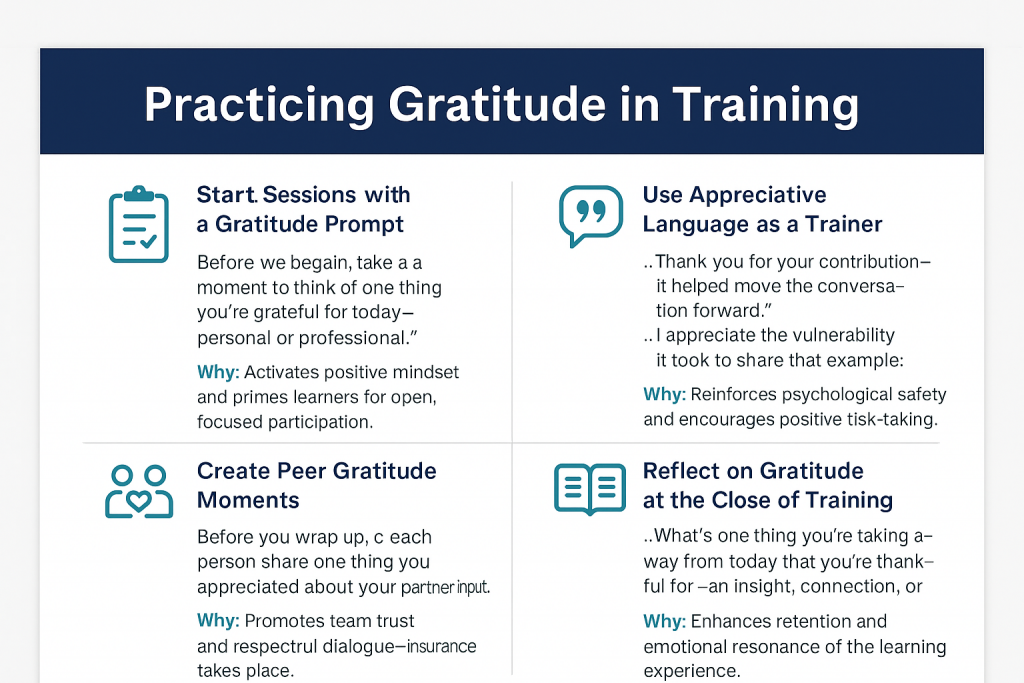
a. Start Sessions with a Gratitude Prompt
Open sessions with a 1-minute gratitude activity.
Example:
“Before we begin, take a moment to think of one thing you’re grateful for today—personal or professional. Type it in the chat or jot it in your notes.”
Why: Activates positive mindset and primes learners for open, focused participation (Lyubomirsky, 2008).
b. Use Appreciative Language as a Trainer
Model gratitude through affirmations and acknowledgment.
Example:
“Thank you for your contribution—it helped move the conversation forward.”
“I appreciate the vulnerability it took to share that example.”
Why: Reinforces psychological safety and encourages positive risk-taking (Edmondson, 2019).
c. Create Peer Gratitude Moments
Build peer-to-peer appreciation into group tasks or reviews.
Example:
At the end of a breakout session, ask: “Before you wrap up, each person share one thing you appreciated about your partner’s input.”
Why: Promotes team trust and respectful dialogue—especially important in diverse or cross-functional training groups.
d. Reflect on Gratitude at the Close of Training
End sessions with structured gratitude reflections.
Example:
“What’s one thing you’re taking away from today that you’re thankful for—an insight, connection, or action?”
You can also use gratitude journaling prompts:
What went well for me in this training?
Who supported me and how?
What challenge am I grateful for having faced today?
Why: Enhances retention and emotional resonance of the learning experience (Fredrickson, 2009).
4. Gratitude and Emotional Intelligence
Integrating gratitude fosters emotional intelligence (EQ), essential for leadership, collaboration, and resilience.
Self-awareness: Gratitude helps learners reflect positively on their experience.
Social awareness: Encourages appreciation of diverse perspectives.
Relationship management: Supports feedback, coaching, and collaboration.
Trainer Tip: Recognise that not all learners will feel comfortable with open gratitude at first—normalise this and allow multiple formats (spoken, written, anonymous).
5. Tools for Implementing Gratitude in Training
Tool Function Example Use
Gratitude Wall Virtual or physical board for posting shoutouts or thanks Use Padlet, Jamboard, or flipcharts
Gratitude Jar Collect and share anonymous notes of appreciation End-of-day review or energiser
Daily Gratitude Check-In Ongoing habit for multi-day training programmes Begin each session with one grateful reflection
Kudos Cards Printed or digital cards to exchange thanks Team-based exercises and reviews
6. Trainer Self-Practice: The Power of Modelling
Your mindset shapes the training space. Practising gratitude yourself is a leadership behaviour that sets the emotional tone.
Ways trainers can build their own gratitude:
Reflect on what went well after each session
Acknowledge participants and co-facilitators regularly
Keep a personal gratitude journal to avoid burnout
Example: “I’m really grateful for the way this group stayed curious today despite the complexity of the topic.”
Why: Demonstrates authentic leadership and models values-based facilitation (Grant & Kinman, 2014).
7. Challenges and Considerations
Gratitude should never be forced or used to dismiss hardship (i.e., toxic positivity). It should coexist with real challenges and lived experience.
Trainer Cautions:
Don’t use gratitude to silence criticism or feedback.
Ensure inclusive delivery—some may prefer private over public expressions.
Frame gratitude as a growth tool, not a performance expectation.
More examples of using appreciative language
1.
“Thanks for asking that question—it shows you’re really engaging with the material.”
Why: Validates curiosity and fosters a culture where questioning is welcomed.
2.
“I really value how you linked that point to your own experience—it made the learning more relatable.”
Why: Encourages reflective thinking and validates personal connection to content.
3.
“That was a thoughtful observation—thank you for adding depth to our discussion.”
Why: Highlights critical thinking and positions the learner as a co-contributor.
4.
“Thanks for staying with us through that challenging exercise—it shows great perseverance.”
Why: Acknowledges effort and builds learner resilience.
5.
“I noticed how you supported your group just now—thank you for modelling great teamwork.”
Why: Reinforces collaborative values and peer learning.
6.
“I appreciate your honesty in that reflection—it created space for others to open up too.”
Why: Promotes emotional intelligence and normalises vulnerability.
7.
“Thanks for being open to feedback—it’s a strong indicator of your growth mindset.”
Why: Encourages receptivity and continuous improvement.
8.
“Thank you for bringing that alternative perspective—it enriched the conversation.”
Why: Supports diversity of thought and respectful challenge.
9.
“I’m grateful for how you handled that feedback—you responded with such professionalism.”
Why: Recognises maturity and role-model behaviour in handling critique.
10.
“You’ve made real progress since the last session—I appreciate the effort you’re putting in.”
Why: Celebrates growth and motivates continued commitment.
Conclusion
Practising gratitude in training is more than a wellness trend—it’s a strategic tool that enhances the emotional, cognitive, and relational aspects of learning. By intentionally embedding gratitude into facilitation practice, trainers contribute to more engaged, resilient, and human-centred training environments.
References (Harvard Style)
Edmondson, A.C., 2019. The Fearless Organization: Creating Psychological Safety in the Workplace for Learning, Innovation, and Growth. Hoboken: Wiley.
Emmons, R.A. and McCullough, M.E., 2003. Counting blessings versus burdens: An experimental investigation of gratitude and subjective well-being in daily life. Journal of Personality and Social Psychology, 84(2), pp.377-389.
Emmons, R.A. and Stern, R., 2013. Gratitude as a psychotherapeutic intervention. Journal of Clinical Psychology, 69(8), pp.846–855.
Fredrickson, B.L., 2009. Positivity: Groundbreaking Research to Release Your Inner Optimist and Thrive. New York: Crown.
Grant, L. and Kinman, G., 2014. Developing resilience for social work practice. Palgrave Macmillan.
Lyubomirsky, S., 2008. The How of Happiness: A New Approach to Getting the Life You Want. New York: Penguin.
Seligman, M.E.P., 2011. Flourish: A Visionary New Understanding of Happiness and Well-being. New York: Free Press.
Wood, A.M., Froh, J.J. and Geraghty, A.W.A., 2010. Gratitude and well-being: A review and theoretical integration. Clinical Psychology Review, 30(7), pp.890-905.