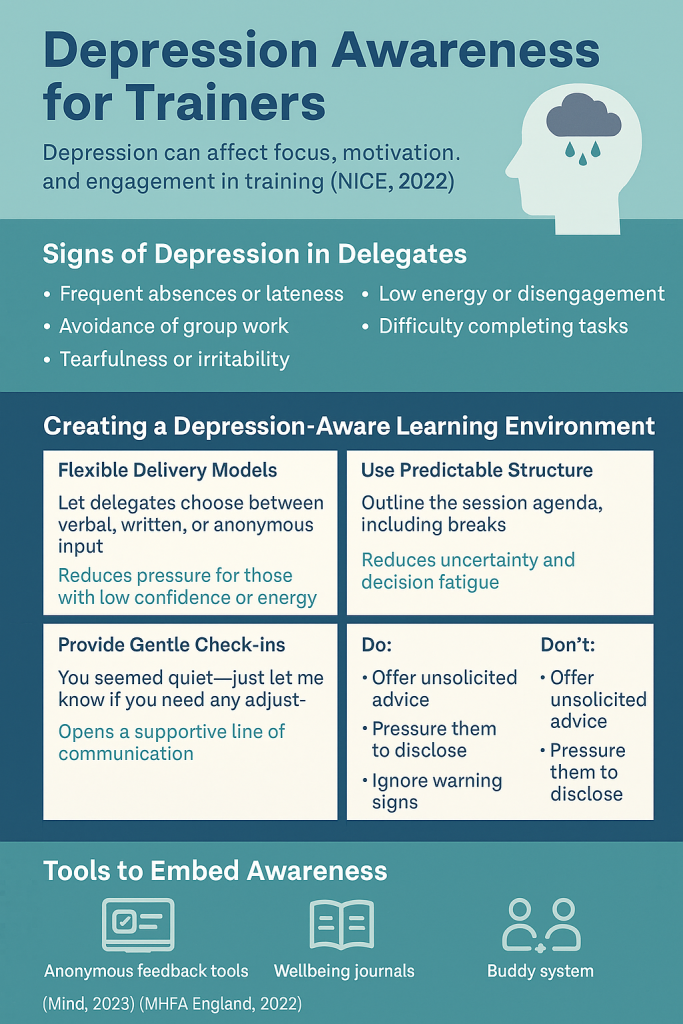
As training professionals, we are uniquely positioned to shape not just skills but also psychological experiences. Awareness of mental health issues, particularly depression, is vital for fostering inclusive, safe, and effective learning spaces. Depression can impact focus, motivation, self-worth, and interpersonal communication—all of which directly affect training outcomes. This guide equips trainers with the tools and insight to identify signs of depression, respond sensitively, and create structured environments that promote participation and psychological wellbeing.
1. Understanding Depression in the Training Context
Depression is more than temporary sadness. It is a serious mental health condition that affects how individuals feel, think, and function daily. Symptoms often include persistent low mood, fatigue, difficulty concentrating, feelings of worthlessness, and withdrawal from social activities (NICE, 2022).
Why it matters in training:
Depression may inhibit:
Engagement with materials or peers
Confidence in contributing
Capacity for sustained attention
Response to feedback
Ignoring these factors can lead to disengagement, underperformance, or dropout, regardless of the delegate’s actual capability.
2. Recognising Depression in Delegates
As a trainer, you are not expected to diagnose, but you should be equipped to recognise behavioural cues that could indicate depression:
Observable signs may include:
Frequent absences or lateness
Low energy or disengaged body language
Avoidance of group work
Difficulty completing tasks
Tearfulness or irritability
Example: A normally communicative learner becomes increasingly withdrawn, avoids eye contact, and contributes minimally across sessions. Rather than viewing this as disinterest, a trauma-informed trainer sees this as a potential red flag for emotional distress.
3. Creating a Depression-Aware Learning Environment
A depression-aware training space promotes empathy, agency, and support without stigma or pressure.
Strategies:
a. Flexible Delivery Models
Allowing choice in how learners engage can be empowering.
Example: Let delegates choose between verbal participation, written input, or anonymous contributions via apps like Mentimeter or Padlet.
Why: This reduces pressure for those with low confidence or energy, helping them remain engaged at a comfortable level (Mind, 2023).
b. Use Predictable Structure
Depression can cause cognitive fatigue. A clear agenda helps learners prepare mentally and emotionally.
Example: Begin each session with a visual overview of the day’s flow, including break times.
Why: Reduces uncertainty and decision fatigue, which can be overwhelming for those with depressive symptoms (Brown & Harris, 2019).
c. Provide Gentle Check-ins
Build rapport through short well-being check-ins, either informally or via private message/email.
Example: “I noticed you seemed quiet during the group task—if there’s anything you’d like to talk about or adjust, I’m here.”
Why: This opens a supportive line of communication while respecting personal boundaries (MHFA England, 2022).
4. Effective Responses: What Trainers Can Do
You don’t need to “fix” depression, but your response can make a profound difference.
Do:
Listen non-judgmentally.
Validate their experience: “That sounds tough—thank you for telling me.”
Offer practical support (e.g., adjusted deadlines).
Signpost to resources (e.g., HR, counselling, MHFA support).
Don’t:
Offer unsolicited advice.
Pressure them to disclose or “cheer up”.
Ignore warning signs.
Example: A delegate says, “I’m not sure I can keep up.”
Trainer response: “Let’s explore what flexibility we can build in so you feel more supported.”
Why: Empathetic engagement encourages learners to remain in training while addressing their unique needs.
5. Tools to Embed Depression Awareness in Training
Tool/Technique Description Why It’s Valuable
Anonymous feedback tools Use platforms like Slido or Google Forms for reflections. Encourages honesty and surfaces hidden struggles.
Wellbeing Journals Encourage private daily logs/reflections. Helps delegates self-monitor and build awareness.
Buddy System Peer support partnerships. Increases social connection, reduces isolation.
6. Trainer Reflection and Boundaries
Recognising depression in others requires emotional labour. Trainers must reflect on their capacity and maintain professional boundaries.
Tips:
Debrief emotionally intense sessions with a peer or mentor.
Know your referral channels (e.g., safeguarding leads, HR).
Avoid over-functioning—your role is to support, not to rescue.
7. Evaluating and Evolving Practice
Build mental health indicators into your training evaluation:
Sample evaluation prompts:
“I felt supported during times of low energy or motivation.”
“The trainer was approachable if I struggled emotionally.”
“The learning environment supported my mental wellbeing.”
Use this data to continually refine your mental health-informed practices.
Conclusion
Raising awareness of depression within the training context is not an add-on—it’s a core competency for 21st-century professional trainers. Through awareness, flexibility, compassion, and proactive design, you can help learners facing depression not only survive training, but thrive.
References (Harvard Style)
Brown, G. W., & Harris, T., 2019. The Social Origins of Depression: A Study of Psychiatric Disorder in Women. London: Routledge.
MHFA England, 2022. Mental Health First Aid Manual. London: Mental Health First Aid England.
Mind, 2023. Depression and Training: Supporting Staff and Delegates. [online] Available at: https://www.mind.org.uk [Accessed 7 June 2025].
NICE, 2022. Depression in Adults: Treatment and Management. [NG222] [online] Available at: https://www.nice.org.uk/guidance/ng222 [Accessed 7 June 2025].
Guide for Trainers: Depression Awareness in Training Environments
 By
/ 06/07/2025
By
/ 06/07/2025