n a world where knowledge doubles every few years, the need for fast, effective, and meaningful learning has never been more urgent. Accelerated learning offers a powerful framework to help trainers design and deliver training that is not only quicker but also more engaging and impactful. Rooted in neuroscience, psychology, and educational theory, accelerated learning aligns with how the brain naturally learns best. This article outlines the key guiding principles of accelerated learning and offers practical strategies trainers can apply immediately.
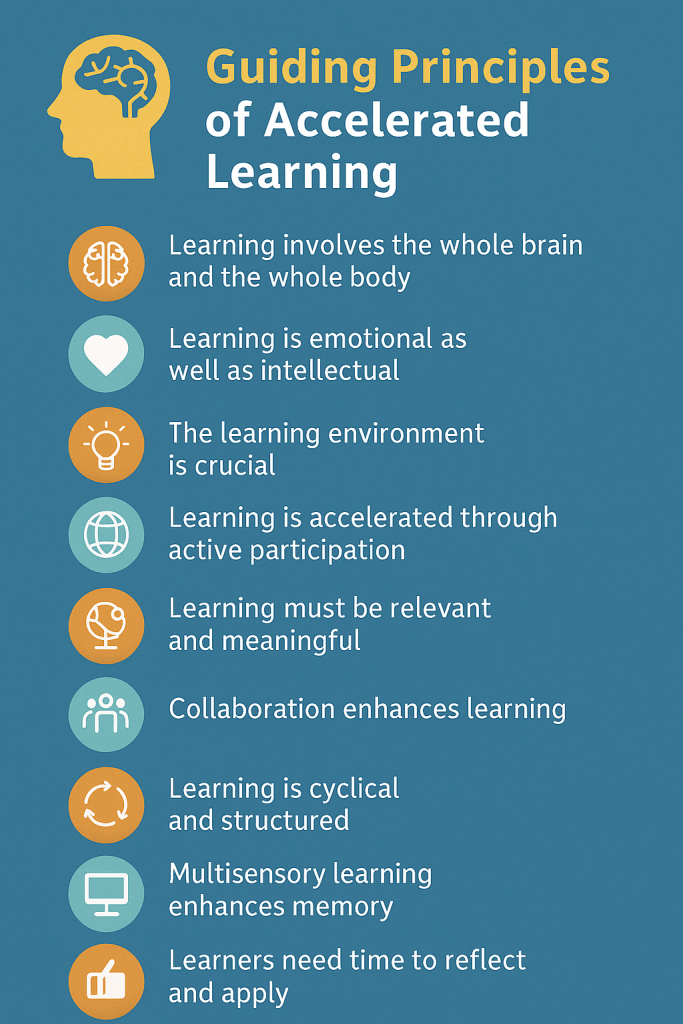
1. Learning Involves the Whole Brain and the Whole Body
Accelerated learning recognizes that effective learning engages both hemispheres of the brain and integrates physical, emotional, and cognitive dimensions.
Practical Application:
Use music, visual aids, storytelling, and movement to stimulate both left and right brain functions (Jensen, 2008).
Include physical activities like role-plays or energizers to increase oxygen flow and keep learners alert and engaged.
Example: Begin a session with upbeat music and a movement-based icebreaker to activate whole-brain learning.
2. Learning is Emotional as Well as Intellectual
Emotions play a key role in memory and attention. Learners retain more when they are emotionally invested and feel safe and supported (Immordino-Yang & Damasio, 2007).
Practical Application:
Create a safe and positive environment with clear expectations and encouragement.
Use real-life examples, humour, and personal stories to connect emotionally with learners.
Example: Ask learners to share a personal success related to the topic to spark emotional relevance and ownership.
3. The Learning Environment is Crucial
The physical and psychological setting of the training has a powerful effect on learner performance.
Practical Application:
Ensure comfortable, flexible seating, natural lighting, and inspiring visuals.
Arrange the room to encourage collaboration rather than passive absorption.
Example: Use circular seating or group tables to foster interaction and shared learning.
4. Learning is Accelerated Through Active Participation
Active learning is far more effective than passive listening. The brain learns best by doing, not just by hearing or seeing (Kolb, 1984).
Practical Application:
Replace lectures with interactive tasks, such as simulations, group discussions, or problem-solving activities.
Ask learners to teach back new concepts to reinforce their understanding.
Example: After introducing a new model, have learners apply it to a scenario in small groups.
5. Learning Must Be Relevant and Meaningful
Adults learn best when content connects to real-world goals and personal relevance (Knowles, Holton & Swanson, 2015).
Practical Application:
Start sessions by clarifying “What’s in it for me?”
Encourage learners to set their own learning objectives and link content to their roles or challenges.
Example: Use case studies from the learners’ workplace or industry to demonstrate application.
6. Collaboration Enhances Learning
Social interaction boosts engagement, motivation, and understanding. Peer learning activates different parts of the brain and reinforces retention (Vygotsky, 1978).
Practical Application:
Design peer-to-peer teaching, group projects, or discussion circles into your sessions.
Promote a culture of feedback, sharing, and mutual support.
Example: Assign “learning buddies” to reflect on and review key content together.
7. Learning is Cyclical and Structured
Accelerated learning aligns with the brain’s natural learning cycle: Preparation, Presentation, Practice, and Performance/Review (Rose, 1997).
Practical Application:
Structure sessions to include pre-learning activities (like pre-reading or quizzes), interactive delivery, skills practice, and review/feedback.
Use spaced repetition and revision games to reinforce learning over time.
Example: Revisit key points through a quiz or game at the end of the session or after a few days.
8. Multisensory Learning Enhances Memory
Engaging multiple senses creates more neural pathways, improving both understanding and retention (Sousa, 2011).
Practical Application:
Use visuals, audio, movement, and manipulatives to deliver content.
Encourage learners to draw, speak, and write about what they’re learning.
Example: Ask participants to create mind maps or sketchnotes of key takeaways.
9. Learners Need Time to Reflect and Apply
Reflection consolidates learning by linking theory to practice and allowing insight to emerge (Kolb, 1984).
Practical Application:
Build in quiet reflection time, journals, or group debriefs.
Ask learners to set action plans for applying knowledge in real contexts.
Example: Close the session with a “What? So What? Now What?” reflection activity.
10. Learning is Enhanced by Positive Suggestion
Language, tone, and suggestion influence learner mindset and openness to learning (Lozanov, 1978).
Practical Application:
Use affirming language, growth mindset phrases, and positive framing throughout the session.
Avoid phrases that imply difficulty or failure (e.g., “This is hard” vs. “You’ll find this interesting”).
Example: Begin by affirming learners’ capabilities and reminding them of past successes.
Conclusion
Accelerated learning is not just a technique—it’s a mindset. As trainers, applying these principles can dramatically increase the impact of our work, helping learners absorb more, retain it longer, and apply it faster. By designing learning experiences that are active, engaging, and brain-friendly, we empower people to learn not just efficiently, but joyfully and meaningfully.
References (Harvard Style)
Immordino-Yang, M.H. and Damasio, A., 2007. We feel, therefore we learn: The relevance of affective and social neuroscience to education. Mind, Brain, and Education, 1(1), pp.3–10.
Jensen, E., 2008. Brain-Based Learning: The New Paradigm of Teaching. 2nd ed. Thousand Oaks, CA: Corwin Press.
Knowles, M.S., Holton, E.F. and Swanson, R.A., 2015. The Adult Learner: The Definitive Classic in Adult Education and Human Resource Development. 8th ed. New York: Routledge.
Kolb, D.A., 1984. Experiential Learning: Experience as the Source of Learning and Development. Englewood Cliffs, NJ: Prentice Hall.
Lozanov, G., 1978. Suggestology and Outlines of Suggestopedy. New York: Gordon and Breach.
Rose, C., 1997. Accelerated Learning: How You Learn Faster and Remember More. London: Accelerated Learning Systems Ltd.
Sousa, D.A., 2011. How the Brain Learns. 4th ed. Thousand Oaks, CA: Corwin Press.
Vygotsky, L.S., 1978. Mind in Society: The Development of Higher Psychological Processes. Cambridge, MA: Harvard University Press.
Guiding Principles of Accelerated Learning: A Practical Guide for Trainers
 By
/ 06/07/2025
By
/ 06/07/2025