Introduction
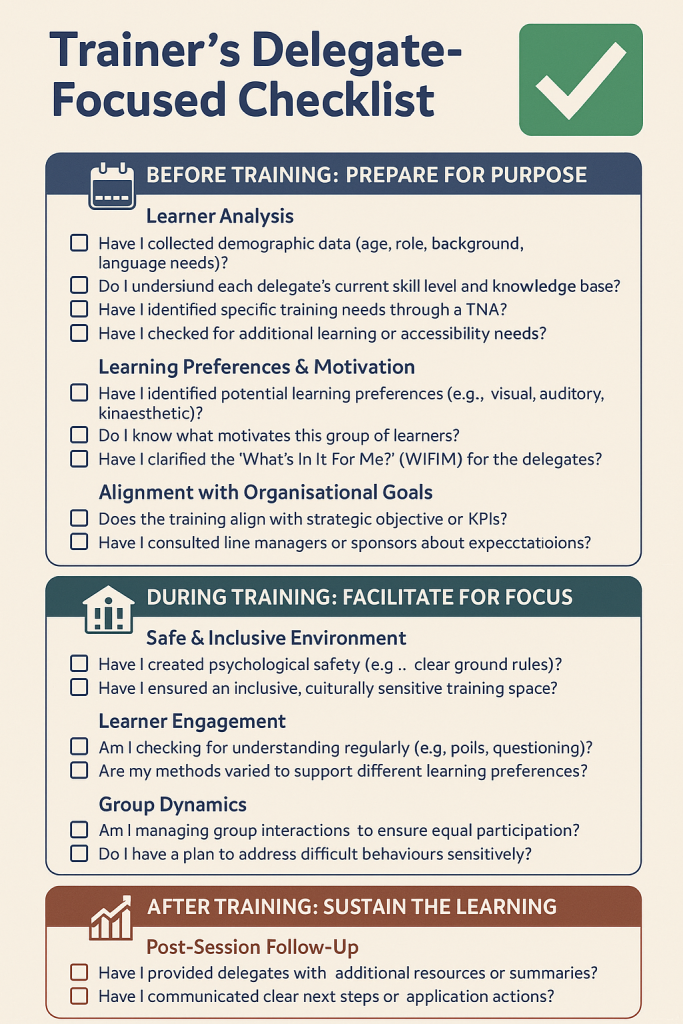
Effective training design begins not with content, but with a deep understanding of the learners. In accelerated and adult learning environments, trainers must tailor sessions based on who the delegates are, what they need, how they learn, and how outcomes are to be sustained post-training. A delegate-focused strategy enhances engagement, retention, and real-world application (Knowles et al., 2015).
1. Pre-Training: Gathering Intelligence
A. Demographic Profiling
Understanding the age, background, experience level, and cultural diversity of your learners allows for differentiation and culturally responsive training (Brookfield, 2013).
Questions to consider:
What roles do delegates hold?
What is their level of prior knowledge?
Are there any accessibility needs?
Tip: Use pre-course questionnaires or registration forms to collect this information.
B. Learning Preferences and Styles
While learning styles theories (e.g., VARK or Honey & Mumford) are contested, understanding preferences is useful for varied instructional design (Pashler et al., 2008).
Action: Incorporate multimodal resources—visuals, discussion, hands-on activities—to appeal to different learning modalities.
C. Training Needs Analysis (TNA)
A TNA identifies gaps between current and desired competencies (Bee & Bee, 1994). Engage stakeholders to understand business goals and how training supports them.
Tools: Surveys, interviews, focus groups, and existing performance data.
D. Emotional and Motivational Readiness
Assess delegates’ motivation to learn. Are they attending voluntarily or under compulsion? This affects engagement (Deci & Ryan, 2000).
Intervention: Communicate the WIIFM (What’s In It For Me?) clearly from the outset.
2. During Training: Managing the Human Dynamic
A. Psychological Safety
Creating a safe space is critical. Delegates are more likely to engage when they feel respected and free from judgment (Edmondson, 1999).
Strategy: Establish ground rules collaboratively. Acknowledge all contributions.
B. Group Dynamics
Each training session has its own culture. Monitor dominant voices, quiet participants, and subgroup formation.
Trainer Tip: Rotate group activities and use reflective prompts to ensure balanced participation.
C. Adaptation in Real Time
Be flexible. Learner pace, unexpected questions, or emotional responses can shift your agenda.
Be agile: Adjust timing, use live polling tools, or rearrange sessions based on live feedback.
D. Continuous Learner Feedback
Use informal check-ins, mood boards, and post-activity evaluations to understand real-time learning effectiveness.
3. Post-Training: Embedding and Evaluating Impact
A. Follow-Up Support
Learning doesn’t stop when the session ends. Continued engagement improves retention and transfer to the workplace (Brinkerhoff, 2006).
Actions:
Provide resources (cheat sheets, videos, slides)
Host a follow-up Q&A or community of practice
Share reflective prompts or assignments
B. Measuring Learner Impact
Use Kirkpatrick’s Four Levels: Reaction, Learning, Behaviour, and Results (Kirkpatrick & Kirkpatrick, 2006).
Key Question: What changed in the delegate’s behaviour or workplace output as a result of the training?
C. Individual Learner Reflection
Encourage learners to articulate how they will apply the learning.
Tool: Post-course reflective journal or action plan.
Conclusion
Planning for training is not just about designing content—it’s about crafting experiences that start with understanding the learner. By investigating who the delegates are before training, tuning into their needs during delivery, and supporting them afterwards, trainers can ensure lasting transformation rather than temporary instruction.
References
Bee, F. & Bee, R. (1994) Training Needs Analysis and Evaluation. London: Institute of Personnel and Development.
Brinkerhoff, R. O. (2006) Telling Training’s Story: Evaluation Made Simple, Credible, and Effective. San Francisco: Berrett-Koehler.
Brookfield, S. D. (2013) The Skillful Teacher: On Technique, Trust, and Responsiveness in the Classroom. 3rd ed. San Francisco: Jossey-Bass.
Deci, E. L. & Ryan, R. M. (2000) ‘The “What” and “Why” of Goal Pursuits: Human Needs and the Self-Determination of Behavior’, Psychological Inquiry, 11(4), pp. 227–268.
Edmondson, A. (1999) ‘Psychological Safety and Learning Behavior in Work Teams’, Administrative Science Quarterly, 44(2), pp. 350–383.
Kirkpatrick, D. L. & Kirkpatrick, J. D. (2006) Evaluating Training Programs: The Four Levels. 3rd ed. San Francisco: Berrett-Koehler.
Knowles, M. S., Holton, E. F. & Swanson, R. A. (2015) The Adult Learner: The Definitive Classic in Adult Education and Human Resource Development. 8th ed. Oxford: Routledge.
Pashler, H., McDaniel, M., Rohrer, D. & Bjork, R. (2008) ‘Learning Styles: Concepts and Evidence’, Psychological Science in the Public Interest, 9(3), pp. 105–119.
Trainer’s Guide to Planning Training: Understanding Your Delegates
 By
/ 06/07/2025
By
/ 06/07/2025