Abstract
Training Needs Analysis (TNA) is a cornerstone of strategic learning and development within organisations. For trainers, understanding how to conduct a comprehensive TNA enables the alignment of learning interventions with organisational goals and learner profiles. This article explores the definition, significance, practical application, and modern tools associated with TNA. It provides trainers with actionable insights to future-proof their practice in a rapidly evolving training landscape.
1. Introduction
Training without needs analysis is like prescribing medicine without diagnosis. In the context of workplace learning, a Training Needs Analysis (TNA) systematically identifies the gap between current and desired performance to inform targeted training interventions (Bee & Bee, 2003). For professional trainers, it is not just a preliminary step but an integral phase in the learning and development (L&D) cycle that ensures relevance, return on investment (ROI), and learner engagement.
2. What is Training Needs Analysis?
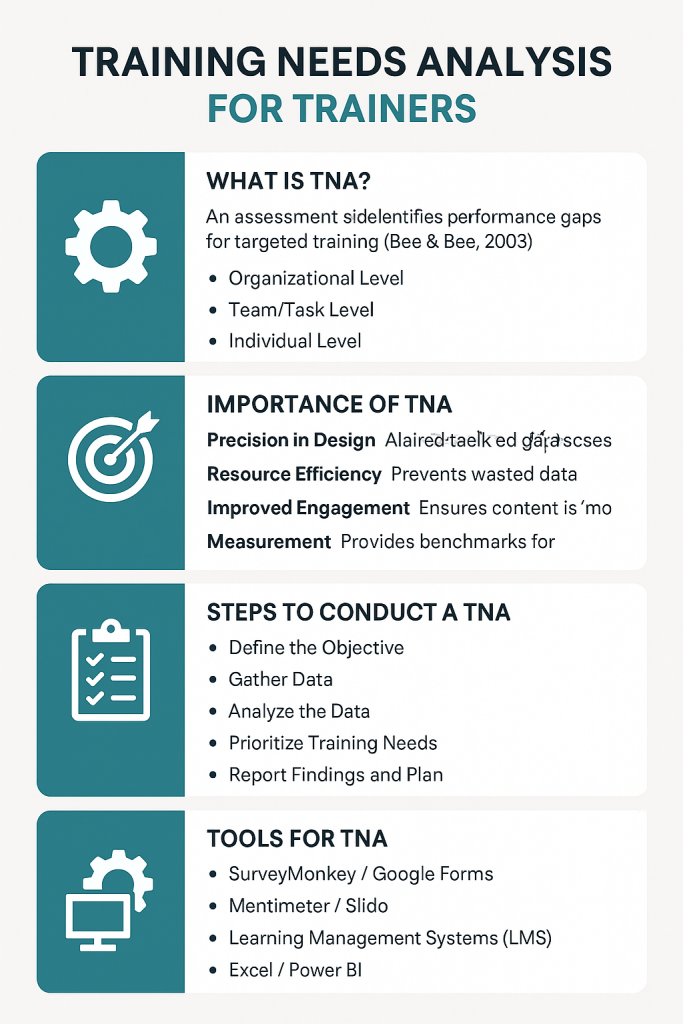
TNA is a diagnostic process used to determine whether a training need exists and, if so, what kind of training is required to close identified performance gaps (McArdle, 2010). It can be conducted at three interrelated levels:
Organisational Level: Aligns training with strategic objectives.
Team/Task Level: Identifies skill and knowledge gaps within specific roles.
Individual Level: Focuses on personal performance and development needs.
This three-tiered approach ensures that training interventions are not only reactive but also strategic and forward-thinking (CIPD, 2021).
3. Why is TNA Important for Trainers?
For trainers, TNA offers multiple advantages:
Precision in Design: Allows tailored training programs aligned with real-world needs.
Resource Efficiency: Prevents wasted resources on redundant or ineffective content.
Improved Engagement: Ensures content is meaningful and motivating for learners.
Measurement: Provides benchmarks for evaluating impact (Phillips & Phillips, 2016).
TNA is particularly critical in sectors such as health, education, and social care, where training must be evidence-informed, timely, and aligned with compliance frameworks.
4. Practical Advice: How to Conduct a Training Needs Analysis
Step 1: Define the Objective
Clearly outline what the TNA aims to achieve. Ask: What are the business goals? What behavioural or performance changes are desired?
Step 2: Gather Data
Use both quantitative (e.g., KPIs, performance metrics) and qualitative (e.g., interviews, observations) methods.
Surveys and Questionnaires: Efficient for gathering widespread data.
Interviews and Focus Groups: Provide rich, contextual insights.
Observation: Allows first-hand assessment of behaviours and workflows.
Performance Appraisals: Offers historical data on individual or team performance.
Step 3: Analyse the Data
Identify trends, gaps, and inconsistencies. Use frameworks such as SWOT (Strengths, Weaknesses, Opportunities, Threats) or GAP Analysis to structure your findings (Mankin, 2009).
Step 4: Prioritise Training Needs
Not all gaps require training. Differentiate between:
Knowledge or skill gaps – suitable for training.
Motivational or structural gaps – may require managerial or organisational change.
Step 5: Report Findings and Plan the Intervention
Translate the analysis into a training proposal. Use SMART objectives (Specific, Measurable, Achievable, Relevant, Time-bound) to guide curriculum design.
5. Recommended Tools and Technologies
Modern TNA benefits from digital tools that enhance data collection, analysis, and presentation:
SurveyMonkey / Google Forms – for custom surveys.
Mentimeter / Slido – live polls to gauge group sentiment.
Learning Management Systems (LMS) – integrate learner analytics.
Excel / Power BI – powerful for data visualisation and trend mapping.
AI-Powered Tools (e.g., ChatGPT) – can generate custom questionnaires or suggest skill benchmarks.
Leveraging these technologies allows for more agile, data-driven, and scalable TNA processes.
6. Future-Proofing TNA: Emerging Trends
As organisations face continual disruption, TNA is evolving. Key trends include:
Skills Forecasting – using labour market intelligence to predict future competencies.
Continuous Needs Analysis – adopting an iterative, real-time approach rather than one-off studies.
Inclusion and Equity Audits – ensuring training is aligned with diversity and accessibility goals.
AI and Predictive Analytics – identifying learning needs before performance gaps emerge (Berger & Frey, 2016).
Trainers must become strategic learning consultants, capable of advising on capability development across the organisation.
7. Conclusion
TNA is not a bureaucratic hurdle but a powerful strategic tool. For trainers, mastering TNA unlocks the capacity to deliver high-impact, learner-centred, and value-driven training solutions. As learning demands grow increasingly complex, a well-executed TNA will remain the linchpin of effective practice.
References
Bee, F. & Bee, R. (2003). Training Needs Analysis and Evaluation. London: CIPD.
Berger, T. & Frey, C. B. (2016). Structural transformation in the OECD: Digitalisation, deindustrialisation and the future of work. OECD Social, Employment and Migration Working Papers, No. 193.
CIPD (2021). Learning and development strategy. [online] Available at: https://www.cipd.co.uk/knowledge/strategy/development/factsheet [Accessed 7 Jun 2025].
Mankin, D. (2009). Human Resource Development. Oxford: Oxford University Press.
McArdle, G. (2010). Conducting a Needs Analysis. Alexandria: ASTD Press.
Phillips, J. J. & Phillips, P. P. (2016). Handbook of Training Evaluation and Measurement Methods. New York: Routledge.
Training Needs Analysis (TNA): A Strategic Guide for Trainers
 By
/ 06/07/2025
By
/ 06/07/2025